How to Upgrade Your RC Car Suspension

Photo: @dlinnaya88 via Unsplash
In this article
Affiliate disclosure: As an Amazon Associate, RemoteControlCarsBlog may earn from qualifying purchases.
Upgrading your RC car’s suspension is one of the most rewarding mods you can make — better handling, smoother landings, more grip, and far more durability. And it’s easier than you think. This complete tutorial teaches you what to upgrade and how to tune it, the easy way.
Your suspension is what keeps your car planted, soaks up bumps, and lands your jumps — so improving it transforms how the car drives. The single best place to start is fitting quality oil-filled RC shocks See RC shocks on Amazon #ad and then tuning them.
We’ll cover what each part does, the upgrades that matter most, and the pro tuning levers — shock oil weight and spring rate — that let you dial in the perfect feel for your terrain. Let’s transform how your car handles. 🔧
📋 What’s Inside (Table of Contents)
- Why upgrade your suspension?
- How RC suspension works
- The key upgrades
- The #1 upgrade: oil-filled shocks
- Tuning levers: springs & oil
- The pro secret: shock oil weight
- The tutorial: step by step
- Springs: soft vs. stiff
- Stronger arms & hardware
- Ride height, camber & toe
- Matching setup to terrain
- Common mistakes & pro tips
- FAQ
- Final thoughts
🏁 Why Upgrade Your Suspension?
A car’s suspension controls how it grips, corners, soaks up bumps, and lands jumps — in short, almost everything about how it handles. Many cars, especially budget ones, come with basic suspension: simple plastic shocks with little or no real damping and non-adjustable parts. Upgrading unlocks smoother, more controlled, more confident driving.
The payoffs are big: better grip and stability, smoother jump landings, less bouncing and rolling, more durability from stronger parts, and the ability to tune the car to your terrain and style. Whether you bash, race, crawl, or run flat-out, a good suspension setup makes the car feel like a completely different, far better machine.
Suspension is where the magic of handling lives. The same chassis can feel like a pogo stick or a planted race car depending on its shocks, springs, and setup. Upgrading and tuning it is the closest thing to a transformation you can buy. 🔧
⚙️ How RC Suspension Works
A quick primer makes upgrading make sense. RC suspension has three main jobs handled by three parts. The springs hold the car up and set its ride height and stiffness. The shocks (dampers) control how fast the suspension compresses and rebounds, stopping it from bouncing like a spring alone would. And the suspension arms connect the wheels to the chassis and locate them as they move.
When a wheel hits a bump, the spring compresses to absorb it and the shock controls that movement so the wheel settles smoothly instead of bouncing. Get these three working well together and the tires stay in better contact with the ground — which means more grip, control, and speed. Upgrading is all about improving and tuning this teamwork.
🧩 The Key Upgrades
If you do just one thing, upgrade to oil-filled shocks — it’s the foundation everything else builds on. From there, springs and shock oil let you fine-tune the feel. See RC car parts on Amazon #ad
🥇 The #1 Upgrade: Oil-Filled Shocks
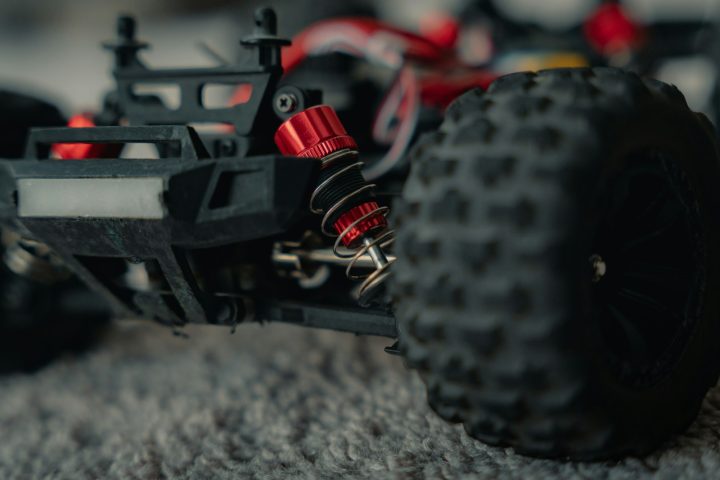
If your car has basic plastic or spring-only shocks, fitting proper oil-filled (hydraulic) shocks is the single most transformative upgrade you can make. Inside an oil shock, a piston pushes through oil as the suspension moves, which smoothly controls how fast it compresses and rebounds — exactly what basic shocks can’t do.
The result is a car that’s far more planted and controlled: it soaks up bumps smoothly, doesn’t bounce around after landings, and keeps its tires in contact with the ground for much better grip. Oil shocks also open the door to real tuning, because you can change the oil and springs inside them. This one upgrade alone can make a budget car feel genuinely high-performance. See oil-filled shocks on Amazon #ad
🎛️ Tuning Levers: Springs & Oil
These are the dials you turn to dial in handling. Springs and shock oil work together — springs set how much the suspension moves, oil sets how fast. Understanding both is the key to a great setup, and the oil is the lever pros lean on most.
🔑 The Pro Secret: Shock Oil Weight
Here’s the tuning knowledge that separates a good setup from a great one: shock oil weight (its thickness, or viscosity, measured in “weight” or wt). The oil’s thickness controls how fast the suspension can move, and changing it dramatically alters how the car feels — for the price of a small bottle of oil.
So if your car feels too bouncy or harsh on rough ground, try thinner oil; if it feels wallowy or bottoms out on jumps, try thicker. Change oil in small steps, test, and feel the difference. This single, inexpensive adjustment is one of the most powerful tuning tools in RC, and knowing how to use it makes you a far more capable driver. See RC shock oil on Amazon #ad
🔧 The Tutorial: Step by Step
Here’s the complete upgrade-and-tune routine. Work through it in order, testing between changes.
- Assess your suspension & goals. Decide what you want — better handling, smoother landings, durability — and what your current setup lacks.
- Upgrade to oil-filled shocks. Fit quality oil shocks as your foundation; this is the biggest single improvement.
- Choose the right springs. Pick spring stiffness to suit your terrain — softer for grip, stiffer for stability.
- Set the shock oil weight. Fill with an oil weight matched to your terrain: thicker for smooth/jumps, thinner for rough.
- Upgrade arms & hardware if needed. Fit stronger arms for durability and any adjustable parts you want.
- Set the ride height. Adjust to suit your surface — lower for on-road stability, higher for off-road clearance.
- Fine-tune camber & toe. Make small alignment adjustments for sharper, more balanced handling.
- Test & tune one change at a time. Drive, feel how it behaves, and adjust a single thing, then re-test.
- Match it to your terrain & style. Settle on a setup that suits how and where you drive.
Take it step by step, change one thing at a time, and keep notes of what works. That’s exactly how the pros find their perfect setup. See RC springs on Amazon #ad
🌀 Springs: Soft vs. Stiff
Springs are your other big tuning lever, and the logic is simple. Softer springs let the suspension move more, which keeps the tires following the ground over bumps and loose surfaces — that means more grip and compliance, ideal for rough or slippery terrain. The trade-off is more body roll and a slightly less responsive feel.
Stiffer springs resist movement more, giving a more stable and responsive car with less roll — great on smooth, high-grip surfaces and at speed. The trade-off is less compliance over bumps. Match spring stiffness to your surface, and remember springs and shock oil work together: springs set how much the suspension moves, oil sets how fast.
💪 Stronger Arms & Hardware
If you bash, jump, or crash a lot, upgrading your suspension arms to tougher composite or aluminum versions pays off in durability. Stock arms on budget cars can snap under hard impacts, so stronger arms mean fewer breakages and less downtime. They also keep the suspension geometry precise under stress.
Beyond arms, adjustable hardware like camber links, sway bars (anti-roll bars), and adjustable shock mounts give you more tuning options as you advance. Sway bars reduce body roll in corners, and adjustable links let you fine-tune the wheel angles. You don’t need all of this at once — add it as your skills and needs grow. See suspension arms on Amazon #ad
📐 Ride Height, Camber & Toe
A few alignment adjustments fine-tune your handling. Ride height is how high the chassis sits — lower gives a more stable, planted feel on-road and in corners, while higher gives the ground clearance you need off-road. Camber is the inward or outward tilt of the wheels; a slight inward tilt (negative camber) often improves cornering grip.
Toe is whether the wheels point slightly in or out, which affects stability and steering response. These are advanced fine-tuning tools, so start with small changes and feel the effect. You don’t need to master them on day one — nail the shocks, springs, and oil first, then explore these for that final bit of polish.
🏞️ Matching Setup to Terrain
There’s no universal “best” setup — the right one depends entirely on where and how you drive. A basher wants durability and compliance, a racer wants stability and precision, and a crawler wants soft articulation. Use these as starting points, then tune from there. Our off-road RC guide pairs well with an off-road setup.
⚠️ Common Mistakes & Pro Tips
Mistake 1: Skipping oil shocks.
Basic shocks limit everything. Fix: Make oil-filled shocks your first upgrade.
Mistake 2: Wrong oil/springs for the terrain.
Hurts handling. Fix: Match oil weight and spring rate to your surface.
Mistake 3: Changing many things at once.
You can’t tell what helped. Fix: One change, then test.
Mistake 4: Not bleeding shocks properly.
Air ruins damping. Fix: Build shocks carefully, free of air bubbles.
Mistake 5: Over-tightening shock screws.
Causes binding. Fix: Snug, not crushed, so shocks move freely.
- Start with oil shocks. They’re the foundation of a great setup.
- Tune with oil weight first. It’s cheap, powerful, and easy to change.
- Match everything to your terrain. The “best” setup is the one for your driving.
- One change at a time. It’s the only way to learn what each tweak does.
- Keep notes. Record setups that work for different conditions.
❓ Frequently Asked Questions
What’s the best first suspension upgrade?
Oil-filled shocks, without question. If your car has basic plastic or spring-only shocks, switching to proper oil-filled (hydraulic) shocks is the single most transformative change you can make. They smoothly control how the suspension compresses and rebounds, keeping the tires on the ground for far better grip, control, and jump landings. They also unlock real tuning through different oils and springs. Start here before any other suspension upgrade.
How does shock oil weight change the handling?
Shock oil weight is its thickness, and it controls how fast the suspension can move. Thicker oil gives slower, firmer damping, which is great for smooth tracks and big jumps where you want controlled, settled movement. Thinner oil gives faster, softer damping, which is better on bumpy, rough terrain where you want the wheels to react quickly and follow the ground for grip. Change it in small steps and test to feel the difference.
Should I use softer or stiffer springs?
It depends on your terrain. Softer springs let the suspension move more, keeping the tires on rough or loose ground for more grip and compliance, at the cost of more body roll. Stiffer springs resist movement for a more stable, responsive feel on smooth, high-grip surfaces and at speed, but offer less compliance over bumps. Match spring stiffness to where you drive, and remember springs and shock oil work together.
Do I need to upgrade the suspension arms too?
Only if you need the durability. If you bash, jump, or crash often and your stock arms break, upgrading to tougher composite or aluminum arms reduces breakages and keeps the geometry precise under stress. If you mostly drive gently or your stock arms hold up fine, you can prioritize shocks, springs, and oil first. Add stronger arms and adjustable hardware like sway bars and camber links as your needs and skills grow.
What ride height should I run?
It depends on your surface. A lower ride height gives a more stable, planted feel with less body roll, which suits on-road driving, racing, and high speed. A higher ride height provides ground clearance to handle rough terrain, bumps, and obstacles, which suits off-road and bashing. Set it appropriately for where you drive, and adjust along with your springs and shock oil as part of dialing in the overall setup.
How do I tune my suspension without guessing?
Change one thing at a time and test between each adjustment, so you always know what made the difference. Start from a sensible baseline for your terrain, then tweak shock oil weight, springs, or ride height individually, driving and feeling the effect each time. Keep notes of setups that work for different conditions. This methodical, one-variable approach is exactly how the pros find their ideal setup, and it removes all the guesswork.
✅ Final Thoughts
Upgrading your suspension, in five points:
- 🥇 Oil-filled shocks are the #1 upgrade — start there.
- 🎛️ Tune with shock oil weight: thicker = firmer, thinner = softer.
- 🌀 Springs: softer for grip, stiffer for stability.
- 💪 Add stronger arms & hardware for durability.
- 🏞️ Match the whole setup to your terrain & style.
Bottom line: upgrading your RC car’s suspension is one of the most satisfying ways to improve how it drives, and it’s very approachable once you understand the parts. Start with oil-filled shocks, then tune with shock oil weight and spring rate to match your terrain, add stronger arms for durability, and fine-tune ride height and alignment for that final polish. Change one thing at a time, test, and keep notes — and your car will grip, corner, and land better than ever. Now go transform your ride. 🔧🏁
More upgrade know-how in our guides on
RC upgrades,
RC car parts,
best off-road RC cars, and
the best RC cars.

admin
Our editors are RC drivers first: every guide is written by someone who has owned, broken and rebuilt the category they cover. No paid placements, no fabricated ratings.